Disability News Service, Resources, Diversity, Americans with Disabilities Act; Local and National.

Monday, January 26, 2015

U.S Department of Labor Appeals Ruling On Home Caregiver Wage Final Rule

as posted by U.S. Department of Labor

DOL Appeals Decision in Lawsuit Brought by Home Care Industry

Update: The Department of Labor has filed an appeal to the U.S. Court of Appeals for the District of Columbia Circuit in the lawsuit brought by associations of home care companies challenging the Home Care Final Rule.
On December 22, 2014, U.S. District Court Judge Richard Leon issued an opinion and order inHome Care Association of America v. Weil, Civil Action No. 14-967 (D.D.C.), vacating the third party regulation amended by the Home Care Final Rule.
On January 14, 2015, Judge Leon issued an opinion and order vacating the Final Rule’s revised definition of companionship services.
The Department strongly disagrees with both orders.
The Department issued the Home Care Final Rule to extend minimum wage and overtime protections to almost 2 million home care workers. The Department stands by the Final Rule. We believe the Rule is legally sound and is the right policy—both for those employees, whose demanding work merits these fundamental wage guarantees, and for recipients of services, who deserve a stable and professional workforce allowing them to remain in their homes and communities.

Information on the Final Rule: Application of the Fair Labor Standards Act to Domestic Service: CLICK HERE


U.S Dept. of Labor Home Care webpage: CLICK HERE

"Let It Go" (Disney's Frozen) performed in American Sign Language ASL, ENJOY!


YouTube Published by dpanvideos on Jan 25, 2015

This is a music video created in American Sign Language out of love towards Frozen's hit song, “Let It Go." This music video was created with a team consisting of a 100% deaf cast and crew. We believe in supporting deaf people everywhere and allowing the sign language community access to one of the best songs in music history.

Directed and Edited by Jules Dameron

Produced by Nick Zerlentes

Performers
Amber Zion & Jason Listman

Frozen’s “Let It Go” Performed by Idina Menzel

American Sign Language Translations by Jules Dameron, Amber Zion and; Jason Listman

* For full production credits go to: https://www.youtube.com/watch?v=g1HVoEW5s50#t=20

Friday, January 23, 2015

Fact Checker of Rand Paul’s claim that ‘over half of people on disability are either anxious or their back hurts’

great article by The Washington Post; By Glenn Kessler | Jan. 23. 2015

(REUTERS/Brian Snyder )
What I tell people is, if you look like me and you hop out of your truck, you shouldn’t be getting a disability check. Over half of the people on disability are either anxious or their back hurts — join the club. Who doesn’t get a little anxious for work and their back hurts?  Everybody over 40 has a back pain. And I am not saying that there are not legitimately people who are disabled.  But the people who are the malingerers are the ones taking the money away from the people who are paraplegic, quadriplegic. You know, we all know people who are horrifically disabled and can’t work, but if you have able bodied people taking the money, then there is not enough money for the people who are truly disabled.”
–Sen. Rand Paul (R-Ky.), remarks in New Hampshire, Jan. 14, 2015
We’re a little late to the controversy over Sen. Rand Paul’s remarks on the Social Security disability insurance (DI) program — that “over half of the people on disability are either anxious or their back hurt” — but it’s an important issue that will have a central role in the political debates this year as the program faces a serious funding crunch. If Congress does not act soon to fix the program’s financing, then the disability insurance trust fund will be depleted by 2016 and benefits would be cut 19 percent.
As can be seen from Paul’s comments, he was being a bit jocular but he also framed his answer as a legitimate statistic that indicated there were many “malingerers” who are “taking money” from more deserving individuals. So what do the data show?

The Facts

The Social Security Administration (SSA) runs the disability program, which is financed through a portion of the 12.4-percent Social Security payroll tax deducted from the paychecks of nearly every worker. As noted in The Fact Checker’s Guide to Social Security, disability insurance is an integral part of Social Security; about 18.5 percent of Social Security beneficiaries are disabled workers and dependents.
Between 1980 and 2010, the number of disabled worker beneficiaries rose 187 percent. The reasons for the sudden rise in costs are complex, but the Social Security Chief Actuary Stephen C. Goss says a key factor is that the baby boom generation is aging and suddenly passing through the period of life (45-64) when disability spikes. In other words, the main part of Social Security will face financial stress when the baby boomers retire — and the disability crisis is a harbinger.
Another factor is that women began working in greater numbers and thus began to qualify more often for disability insurance, though that trend was mitigated by the fact that the undocumented population also grew substantially in this period — and illegal immigrants don’t qualify for coverage. The Great Recession, like all economic downturns, also boosted the number of beneficiaries.
In testimony before Congress, Goss noted that the spike in disability costs as a result of baby boomers hitting this milestone has largely passed. “Restoring sustainable solvency for the DI program will not require continually greater benefit cuts or revenue increases,” he said, just a one-time fix. Here’s a chart from his testimony:
So a large part of the increase in beneficiaries stems from demographic factors, not more people scamming the system. The Government Accountability Office, in a 2013 report on the $128 billion program, documented $1.29 billion in potential overpayments to 36,000 people in 2011 – but these were people who were working and had earnings in excess of $1,000 a month. So it’s hard to call them “malingerers.” The number of people who received overpayments represented just 0.4 percent of beneficiaries, GAO said.
Indeed, it is not easy to qualify for disability. According to SSA, between 2003 and 2012, only 24 percent of disability applicants were initially granted benefits; an average of two and 11 percent were awarded benefits after either reconsideration or a hearing, respectively. Thus an average of 59 percent of applicants were denied benefits, even after appeals. This chart shows the trend over the ten-year period:
Now let’s turn to Paul’s specific statement — that “over half of the people on disability are either anxious or their back hurts.” Where does that come from?
Paul spokesman Brian Darling pointed to two data points — 27.7 percent of disabled beneficiaries are diagnosed as having ailments related to “Musculoskeletal system and connective tissue” and that 14 percent have “mood disorders.” That adds up to 42 percent, he noted. (There’s also nearly 4 percent who cite injuries, which presumably could cover back injuries.)
But William Jarrett, an SSA spokesman, says that anxiety disorders is covered in the “other” category, not under “mood disorders.” The “other” category is just 3.8 percent of beneficiaries; Jarrett said there was no further breakdown. Under the SSA’s definition, anxiety-related disorders is more than just being “anxious for work,” as Paul put it, but includes “recurrent and intrusive recollections of a traumatic experience” and “recurrent severe panic attacks.”
Darling countered that “Senator Paul was referring to mood problems when he used a phrase relating to being anxious.” He argued that any reasonable person would infer that being anxious would qualify under the category of “affective disorders: characterized by a disturbance of mood.”
Jarrett noted that the “mood disorders” category includes conditions like bipolar disorder, major depressive disorder, and dysthymia (persistent depressive disorder).
But there’s another problem—the SSA definition for musculoskeletal category covers far more than back pain, such amputations, all sorts of fractures, burns and spine disorders.  So it’s a bit silly to assume that “back pain” is all of those cases. (A 2013 study by Mathematica Policy Research suggests 18.8 percent of DI-only recipients reported back disorders as a primary impairment; “anxiety disorders” represented 3.2 percent of claims.)
“It should be factored into any analysis that this was a spontaneous response to a question from a New Hampshire resident at an event — not prepared remarks,” Darling said. “Senator Paul never said that people who had back problems and mood disorders are not deserving of help.  He never indicated that 50 percent of claims were fraudulent.”

The Pinocchio Test

We understand that Paul was speaking off-the-cuff, but the clear implication was there were significant numbers of “able bodied people taking the money” through common ailments like back pain and being anxious about work.
But not only is the rate of fraud relatively low, but it mostly involves people who are working who should not be getting payments, rather than people who are getting paid and not working. Moreover, even a generous interpretation of the data does not generate a figure close to more than half of beneficiaries getting paid for simply back pain and anxiety.

Three Pinocchios


http://www.washingtonpost.com/blogs/fact-checker/wp/2015/01/23/rand-pauls-claim-that-over-half-of-the-people-on-disability-are-either-anxious-or-their-back-hurts/


Hiring A Lawyer for Your Social Security Disability Case? 10 Questions to Ask a Lawyer before

The following information is shared by Disability.gov

By Guest Blogger Samuel Packard, a San Antonio Social Security Lawyer and Partner at The Packard Law Firm 
Applying for Social Security Disability benefits is a complicated process, and most people are denied the first time. While hiring legal counsel is not a requirement, some people find that having a lawyer ensures they navigate the process correctly and reduces the stress caused by mountains of paperwork. In my experience, there are 10 questions you should ask a lawyer before hiring him or her for your disability case:
  1. What level of experience does this attorney have with Social Security Disability? You want to know how long the attorney has been helping people with disabilities. If he or she is Board Certified in Social Security Law, that’s a huge plus. Ask how many hearings he or she handles per month. Be careful of working with any attorney who handles more than 30 cases per month because he or she may not be able to spend the time you need on your case.
  1. Will this attorney help fill out your Social Security forms? The attorney or legal assistant should help you with this. They can’t make up the answers for you, but you should not be responsible for filling out the appeals, reports and other forms Social Security sends you. If the attorney tells you to apply on your own for benefits and call back if or when you get your denial letter, then smile and say, “OK,” but keep looking for an attorney.
  1. Will this attorney order your medical records? Having all the medical records available for the judge is crucial to your case. If you are responsible for gathering your own medical records, keep looking.
  1. Is this attorney familiar with the judges and staff at your hearing office? It helps to know the quirks and preferences of the other people who will be there for your hearing, especially the judge. There is turnover among the Social Security staff (including judges), but an attorney should be familiar with most of the people there.
  1. How does this attorney handle your questions or updates about your case? Who do you talk to? This is mainly to see if your communication style matches with the attorney. Some people like to talk over the phone, some like to email. Some want an attorney who answers his own phone, and some want an attorney who has legal assistants who help.
  1. How much does this attorney charge? What if you don’t win? Social Security regulates how attorneys get paid, and as a result, they usually charge the same: 25 percent of past due benefits. However, some attorneys require reimbursement for case expenses even if you don’t win. This might not be a deal killer, but it is something you should be aware of before signing a contract.
  1. How will this attorney help prepare you for the hearing? Will you be able to meet in person (and not just the day of the hearing)? You should be able to meet with your attorney several days before your hearing. Sometimes circumstances make it difficult to meet face-to-face, but doing your hearing preparation meeting over the phone should be your decision. And it should not be done by an assistant or paralegal.
  1. Where is this attorney located? All else being equal, you should go with a local attorney. This might be difficult if you live in a rural area, but find someone who is near your hearing office.
  1. Will this attorney prepare a written memorandum or brief for the judge to review prior to the hearing? This written statement from the attorney is very helpful. First, it shows that your attorney has spent time reviewing your case and preparing a legal theory for the judge. Second, it gives the judge a chance to consider the case prior to the hearing. Finally, it can also be a request for an On The Record (OTR) decision. OTR decisions are rare, but sometimes the judge will grant a claim without hearing testimony from any witnesses.
  1. Is this attorney familiar with your particular health problems? No attorney can know everything about every medical condition, but you should get a feel for how knowledgeable an attorney is on your conditions. If your health problems are uncommon, your attorney should be willing to get familiar with the symptoms and treatment of your particular conditions.
In the end, the most important thing your attorney can do for your case is give you peace of mind. You should look for someone who will help you with this burden. Many people are overly concerned about win percentage or the length of the process. Nobody can guarantee an outcome, and there aren’t many ways a person qualifies to have his or her case expedited.
What you should be most concerned with is finding someone you can trust. You want someone who will take care of your case so you don’t have to worry. If you don’t like the attorney, keep looking until you find someone you like.
A photo of Samuel Packard, a San Antonio Social Security Lawyer and Partner at The Packard Law FirmAbout the Guest Blogger
Samuel Packard is a San Antonio Social Security lawyer who has handled more than a thousand disability cases. He is board certified by the National Board of Social Security Disability Advocacy. Samuel and his brother, Michael, own The Packard Law Firm and continue to help people with disabilities get the disability benefits they need.

https://usodep.blogs.govdelivery.com/2015/01/21/10-questions-to-ask-a-lawyer-before-hiring-one-for-your-disability-case/
For more from Disability.gov, visit: https://usodep.blogs.govdelivery.com/

Section 508 Best Practices Webinar - February 2: Accessible Electronic Documents - Accessible Document in MS Word 2010

Section 508 Best Practices Webinar: Accessible Electronic Documents - Authoring Guide for Making an Accessible Document in MS Word 2010 (Postponed to February 2 from January 27)
The next webinar in the Section 508 Best Practices Webinar Series will take place February 2 from 1:00 to 2:30 (ET) and will review the draft "Authoring Guide for Making an Accessible Document in MS Word 2010." This guide was prepared by the Accessible Electronic Document Community of Practice which has drafted the "Harmonized Processes for Section 508 Testing: Baseline Tests for Accessible Electronic Documents—MS Word 2010" as a best practice. This best practice will establish the minimum steps required to determine whether an electronic document produced in Microsoft Office Word 2010 passes or fails Section 508 requirements. The tests have been agreed upon as part of an effort to provide a unified approach to Section 508 testing across government, to increase consistency, and to build confidence in test results shared between agencies.
For more details or to register for this free webinar, visit www.adaconferences.org/CIOC/.

The Section 508 Best Practices Webinar Series provides helpful information and best practices for federal agencies in meeting their obligations under Section 508 of the Rehabilitation Act which ensures access to electronic and information technology in the federal sector. This webinar series is made available by the Accessibility Community of Practice of the CIO Council in partnership with the U.S. Access Board.
Accessible Electronic Documents - Authoring Guide for Making an Accessible Document in MS Word 2010
January 27, 2015 1:00- 2:30 (ET)

Presenters: 
• Holly Anderson, Policy Liaison for Individuals with Disabilities, Office of Postsecondary Education, U.S. Department of Education
• Crystal Jones, Management and Program Analyst, Office of the Chief Information Officer, U.S. Department of Education
Moderator: Timothy Creagan, Senior Accessibility Specialist, U.S. Access Board
Registration: www.adaconferences.org/CIOC/
Note: Instructions for accessing the webinar on the day of the session will be sent via email to registered individuals in advance of the session. Communication Access Realtime Translation (CART) and Video Sign Language Interpreters are available for each session and will be broadcast via the webinar platform. A telephone option (not toll-free) for receiving audio is also available

* as shared by the United States Access Board

Thursday, January 22, 2015

Medicare Paid Suppliers for Power Mobility Device Claims That Did Not Meet Federal Requirements for Physicians Examinations

from the HHS Office of Inspector General | Jan 22, 2014


Reports

Medicare Paid Suppliers for Power Mobility Device Claims That Did Not Meet Federal Requirements for Physicians' Face-to-Face Examinations of Beneficiaries (A-09-12-02068) http://go.usa.gov/J7ZV
Federal law and regulations require that before a power mobility device (PMD) is covered under Medicare, a physician must conduct and document a face-to-face examination of the beneficiary and write a prescription for the PMD. In 2005, CMS introduced the optional Healthcare Common Procedure Coding System code G0372 for a physician to establish and document the need for a PMD. We refer to a physician claim with the G0372 code as a "G-code claim."
For PMD claims with corresponding G-code claims, Medicare paid the PMD claims in accordance with Federal requirements for face-to-face examinations of beneficiaries. Of the 100 sample claims, we reviewed 94 and concluded that all met the requirements. For six claims, the physicians could not be contacted, and we treated these six claims as non-errors.
For PMD claims without corresponding G-code claims, Medicare did not always pay the PMD claims in accordance with Federal requirements for face-to-face examinations of beneficiaries. Of the 100 sample claims, 53 claims met the requirements, but 47 did not. On the basis of physician interviews, we concluded that many physicians were unfamiliar with the G0372 code. After reviewing medical records, we also concluded that many physicians were not aware of the documentation requirements for face-to-face examinations. Furthermore, CMS did not require durable medical equipment (DME) Medicare contractors to match suppliers' PMD claims to physicians' G-code claims to identify PMD claims that were at high risk of being unallowable. On the basis of our sample results, we estimated that, of the $87.4 million of high-risk claims that we reviewed, Medicare paid approximately $35.2 million in 2010 for PMD claims that did not meet Federal requirements.
We recommended that CMS (1) adjust the 47 sample claims representing overpayments of $115,000 to the extent allowed under the law, (2) require physicians to use the G0372 code when prescribing PMDs, and (3) require Part B Medicare contractors to educate physicians on the use of the G0372 code and the documentation requirements for face-to-face examinations.
After the second and third recommendations have been implemented, any PMD claims without corresponding G-code claims would be at high risk of overpayment. Therefore, to help realize future savings for Medicare, we recommend that CMS require DME Medicare contractors to match suppliers' PMD claims to physicians' G code claims, which would help these contractors to identify and review suppliers with a large number of high-risk PMD claims (i.e., those without corresponding G-code claims) and could have saved an estimated $35.2 million for the 1-year period we reviewed. CMS partially concurred with our first and fourth recommendations and did not concur with our second and third recommendations.

President Obama mentioned People with Disabilities explicitly in the 2015 State of the Union address.

 The reference came on Tuesday Jan. 20, 2015 as part of President Obama's description of the values that make us American.
President Obama during the State of the Union address
"I want future generations to know that we are a people who see our differences as a great gift," he said, "that we are a people who value the dignity and worth of every citizen - man and woman, young and old, black and white, Latino, Asian, immigrant, Native American, gay, straight, Americans with mental illness or physical disability. I want them to grow up in a country that shows the world what we still know to be true:  that we are still more than a collection of red states and blue states; that we are the United States of America."
 VIDEO: Full State of Union Address.  White House

Wednesday, January 21, 2015

‘Success with MS’ workshop for individuals newly diagnosed with multiple sclerosis: Glenview, IL. Feb. 18th

PRESS RELEASE | CHICAGO, Jan. 20, 2015  
Success with MS, a free, two-part program presented by the National Multiple Sclerosis Society, Greater Illinois Chapter, begins on Wednesday, Feb. 18, from 6 p.m. to 7:45 p.m. The second and final session will meet at the same time a week later on Wednesday, Feb. 25. Participants are expected to attend both sessions, which will take place at Glenbrook Hospital, 2180 Pfingsten Road, in Glenview, Ill. The two-part program informs and prepares individuals recently diagnosed with MS for the future. If you have been diagnosed with MS in the last two years, Success with MS will equip you with the tools you need to combat the challenges of living with MS.

Through Success with MS, individuals newly diagnosed with MS will learn about living with MS from experienced health professionals. Kicking-off the program, a neurologist will present on a variety of topics, including what MS is, MS treatment options and MS healthcare providers. In the second session, a social worker or psychologist will discuss implications of living with MS, including sensitive conversations with family, friends and employers as well as financial considerations for the future.
Reservations can be made online at MSillinois.org or by calling 1-800-344-4867. Registration is required; no walk-ins allowed. For questions or more information about Success with MS, contact Nicole Sammartino, client services manager at the Greater Illinois Chapter, at 312-423-1127 or mailto:nicole.sammartino@nmss.org>.

Multiple sclerosis, an unpredictable, often disabling disease of the central nervous system, interrupts the flow of information within the brain, and between the brain and body. Symptoms range from numbness and tingling to blindness and paralysis. The progress, severity and specific symptoms of MS in any one person cannot yet be predicted, but advances in research and treatment are moving us closer to a world free of MS. MS affects more than 20,000 people in Illinois and 2.3 million worldwide
The Greater Illinois Chapter mobilizes people and resources to drive research for a cure and to address the challenges of everyone affected by MS. The Chapter envisions a world free of MS and moves toward that end by driving change through advocacy, facilitating education, collaborating with others and by providing helpful programs and services.
 Visit MSIllinois.org for more information.

Section 508 of The Rehabilitation Act: A Program with Heart


A photo of Helen Chamberlain.
Disability.gov article by Guest Bloggers Helen Chamberlain, Program Director of Section 508, and the General Services Administration Team
A Growing Need
More than 60 million Americans are classified as having a disability; about 19 percent of the total population. More than 50 percent of those Americans with disabilities are in their working years (ages 18-64).(Census)
The federal government is the largest employer of Americans with disabilities and with that comes the responsibility of ensuring equal access to opportunities and information as put forth in Section 508 of the Rehabilitation Act. With our world and workforce becoming increasingly virtual, we rely more and more on technology to ensure those with disabilities are woven seamlessly into the rapidly diversifying fabric of our labor force.
The Section 508 program is at the forefront of this effort, ensuring that agencies are informed about and have access to technology that makes it possible for people with disabilities to not only do their jobs, but also excel at them. As the chief advocate and coordinator for Section 508 implementation, the General Services Administration’s (GSA) Office of Government-wide Policy (OGP) provides accessibility solutions to eliminate barriers for people with disabilities. People like Rita. 
Rita’s Story
A photo of Rita Harrison, a woman who is blind walking with her guide dog Emmett.
Rita is a 508 coordinator with a disability and a federal employee who has benefited from this focus on a technologically accessible workplace. Rita was born with an eye disease called Retinitis Pigmentosa (RP) and has been visually impaired all of her life. Though RP raised many obstacles, she faced the biggest one of her life in 2001 when she was diagnosed with breast cancer. Her chemotherapy treatment left her blind, but she survived. She says of the experience, “My view is, “I’m a breast cancer survivor” and losing my vision was a very small price to pay in exchange for my life, which I cherish and enjoy very much to this day. I’ve learned to never take life for granted because I’ve come to realize the present is a gift and I may not have tomorrow!”
We tell Rita’s story because she is thriving in her work as a federal employee, made possible because of Section 508. “I think it’s great we now have all these avenues that weren’t available to me as I was growing up,” Rita says. “It’s because of reasonable accommodations and Section 508 that I find myself where I am today, which is the 508 coordinator for a federal agency. Because I not only talk the talk, I walk the walk and my agency is walking right alongside of me.”
A Passionate Program
Helen Chamberlain, the government-wide section 508 program director at GSA, is known for her engagement and development of the federal 508 community. “Section 508 has been my passion for many years, and as the GSA/OGP federal government representative, I have been able to share my knowledge and experiences and provide a forum for the Section 508 community to make sure every federal employee and the public have access to all the information and resources the federal government has to offer.”
Helen’s goal is make sure that accessibility is “built in, not bolted on” to electronic and information technology (EIT). That’s a lesson the federal government is taking to heart by making sure that all EIT, which is purchased or used, is accessible to everyone. A key step to improving access happens during the procurement process. Here, Helen and her team help agency acquisition officials in developing Section 508 requirements. The 508 Program at GSA provides valuable tools at BuyAccessible.gov, including the BuyAccessible Wizard and Quick Links tools, which can develop Section 508 requirements and contract language.
Getting Results
Rita’s accomplishments of overcoming multiple obstacles to become a successful 508 coordinator show the individual results Section 508 can have. Katherine, the 508 coordinator at the National Science Foundation (NSF), has seen a lot of organizational success engaging people with disabilities through the support offered by the GSA program. “Through knowledge gained from Section 508 trainings and individual research, I have been able to help NSF increase engagement for both employees and the community at large by counseling them on ways to conduct more accessible meetings. Consequently, a large number of NSF’s outreach information sessions now include online participation via WebEx with real-time captioning (at a minimum), accessible presentation files available to attendees in electronic format, onsite sign language interpretation and assistive listening device systems.”
Katherine has also seen enhanced recruiting efforts that included using accessibility and virtual technology to conduct candidate hiring interviews with remote applicants (with and without disabilities), which limits the need for candidates to make multiple trips to NSF. As a result, several employees with disabilities, including veterans, have been hired.
Every new 508-conformant procurement, service or innovative tool that provides better EIT access to persons with disabilities is a tremendous accomplishment and validation that the lawhelps federal employees and fellow citizens. And as you can see from stories like Rita’s and Katherine’s, the 508 program has both a personal and organizational heart.
If you are an accessibility specialist who has ideas on how to improve accessibility of federal EIT, please share your best practices and implementation approaches via the Request for Information on FedBizOpps. For news and more general information related to Section 508, visit Section508.gov. Anyone with questions concerning Section 508 can contact Helen Chamberlain at GSA or the respective agency’s Section 508 coordinator.
https://usodep.blogs.govdelivery.com/2015/01/20/section-508-a-program-with-heart/
For more from Disability.gov, visit: https://usodep.blogs.govdelivery.com/

Virginia Governor pardon for man with Autism, Reginald “Neli” Latson

Reginald “Neli” Latson


wonderful news Article by DAWNTHEA PRICE / THE FREE LANCE–STAR / Jan 20, 2015
Gov. Terry McAuliffe has signed a conditional pardon for Reginald C. “Neli” Latson, a man with autism and multiple legal troubles in Stafford County.

Latson, 23, was convicted in Stafford Circuit Court Jan. 8 of assault on a law enforcement officer and violating his probation. He had punched an officer at the Rappahannock Regional Jail while being moved to another area. Latson was subdued with a Taser during the incident; the officer was not seriously injured.

He had initially been ordered to serve six months in jail, then be transferred to AdvoServ, a long-term residential treatment facility in Florida, as part of a plea agreement between his attorneys and Commonwealth’s Attorney Eric Olsen.

The Arc, an advocacy group for people with intellectual and developmental disabilities, and the ACLU of Virginia had petitioned McAuliffe for the pardon following his latest charges.

McAuliffe’s official Twitter account posted a message about 2 p.m. Tuesday with a picture of the governor signing a conditional pardon.

Brian Coy, McAuliffe’s spokesman, said the terms of the pardon mean Latson will head directly to AdvoServ without serving the six-month sentence.

Advocates rallied around Latson, claiming that his condition has made it impossible to control violent outbursts that have led to the numerous charges of assault and probation violations he has accrued since 2010. Supporters have called for treatment rather than additional incarceration.

Latson, whose mother has said he has Asperger syndrome, has had multiple altercations with law enforcement in recent years.

He was convicted of multiple charges, including assault of a law enforcement officer and disarming a police officer, after an altercation in May 2010 with Deputy Tom Calverly, then a school resource officer at North Stafford High School.

Though a jury recommended Latson serve 10 years in prison, a judge suspended all but two years. The injuries Calverly sustained from the incident ended his law enforcement career.

While living at a group home in Winchester, Latson also fought with a Frederick County officer in August 2013. He then served nine months after being convicted of assault on a police officer and attempting to disarm a police officer.

For the 2013 incident, Latson was also convicted of a probation violation in Stafford and ordered to serve a yearlong sentence. He is expected to finish that term in February.

AdvoServ’s mission statement says its “unique, comprehensive treatment methodology provides real help and proven results” for individuals with developmental disabilities, mental health issues, conduct disorders or other behavioral issues referred to the program. The provider operates programs in Delaware, Florida and New Jersey.

This story has been updated from a previous version.
http://www.fredericksburg.com/news/crime_courts/governor-issues-pardon-for-man-with-autism/article_e962b93e-a0e9-11e4-8e75-57082a33b6ce.html

###
For previous post:

Accessible Play Areas - "Advanced Session" Webcast Feb. 5th

February 5th, 2015 » Accessible Play Areas - "Advanced Session"(available for registration)

It's been over 2 years since the new accessibility standards have been required for all newly constructed and altered play areas. This session will focus on a more "advanced" level discussion regarding issues such as the selection of suitable playground surfaces, applying the scoping and technical provisions to altered sites, and other more frequently asked questions. Attendees are encouraged to review the previous session on this topic and submit questions in advance for this discussion.

Presenters:

  • Bill R. Botten
    Accessibility Specialist
    Office of Technical and Information Services
    US Access Board
  • Peggy H. Greenwell
    Accessibility Specialist
    Office of Technical and Information Services
    US Access Board

Continuing Education Recognition Available:

  • Certificate of Attendance (Free)
  • AIA CES (free) : 1.5 Learning Units/HSW
  • AICP CES (free) : 1.5 Credits
  • LA CES (free) : 1.5 Credits

To submit questions go to:  www.accessibilityonline.org and select the “Submit Questions” option from the right hand column.   You will be asked to sign into your account before submitting a question to verify that you are registered for this session.

Instructions for accessing the webinar on the day of the event will be sent via email within 24 hours of the start of the session.

NOTE:  Blackboard Collaborate has made changes to their system and how the webinar is “launched”.   You may be prompted to download the Windows Launcher.   Please make sure you go through this process prior to the session.   Questions regarding the launcher and requirements can be found at:
Depending on your organizational policies you may need the assistance of your IT Staff  if firewalls prevent you from downloading files.  

If you are a first time user of the Blackboard Collaborate Web Conferencing System V12.6 that will be utilized for this session it is strongly advised that you go through the “First Time Users” process to make sure that your system is up to date and has the required software.   View the system requirements for Blackboard Collaborate Web Conferencing version 12.6

To verify your system is compatible follow these steps:

Step 1:  Visit Support Portal for Blackboard Collaborate and under the First Time Users option choose “Blackboard Web Conferencing”.  
Step 2:  Verify that you have the correct software version installed on your system.
Step 3:  Use the available configuration room to check your audio settings.  


Individuals who are using Screen Reader Software should review the instructions and information available on-line at:  http://accessibilityonline.org/Accessibility/

Questions regarding the session content should be directed to greenwell@access-board.gov

Questions regarding registration, technical issues with the webinar platform, etc. should be directed to info@adaconferences.org and/or by calling 877-232-1990 (V/TTY)

* as shared by ADA National Network and Great Lakes ADA Center

Illinois Disability Rights Consortium meeting Jan 28th; webcast live

The next meeting of the Disability Rights Consortium will take place on Wednesday January 28th  from 9:30-11:00  CT at Equip for Equality.  

The focus of the meeting will be on Employment.  Specifically, we'll be focusing on the implementation of Employment First in Illinois, which means that competitive integrated employment should be the first option for people with disabilities.  As some of you know, Equip for Equality produced a report called the Blueprint for Employment First.  

At our meeting, Equip for Equality’s Cheryl Jansen, Melissa Picciola and Barry Taylor will review the Blueprint and answer questions.  Please forward this meeting announcement to others who may be interested in this issue.

 The meeting will be Webcast on www.illinoislegaladvocate.org  Just click on “Calendar” and then click on the link for the Consortium meeting to access the meeting remotely. 
The meeting is eligible for 1.5 hours of Continuing Legal Education credit for Illinois attorneys. 

*as shared by Equip for Equality (20 N. Michigan, Suite 300, Chicago, IL.) 

Monday, January 19, 2015

Autistic teenage boys birthday surprise; a 'vacuum salesman' brought tears to all

just have to share from CBS6, article BY SCOTT WISE | Jan 19, 2015

CHESTERFIELD COUNTY, Va. — Ever since he was a two-year-old boy, Dylan Greene has had a passion for vacuum cleaners. Dylan, who has autism, was never into “normal” toys, his mother Jodie said. The Swift Creek Middle School student turned 14 years old over the weekend and celebrated his birthday with a party that included close friends, family and a vacuum salesman.

You see, in an effort to help make her son’s birthday even more special, Jodie Greene sent the following email to the Kirby Company, the Cleveland-based makers of the Kirby vacuum.

I am reaching out to you in hopes for an answer to an unusual request for my son who is autistic. He has always been obsessed with vacuum cleaners. His favorite is the Kirby. He spends hours every day watching videos on his tablet about different Kirby’s. When he isn’t watching videos about them, he is talking about them. I really would LOVE to get a demo done for him for his birthday. In fact, I am even getting him a cake made that looks like a Kirby vacuum. I am writing to you in hopes that you can get me in touch with a way to get him this demo. I want to be clear that I do not intend on purchasing a Kirby. I was hoping that I could pay a flat fee or thought that maybe if you have salesmen in training that needs to get in practice demos for training purposes. I do not want anything free, but as the mother of a special needs child, it is so hard to find things to make my son happy. I know that having this demo done would just be so awesome, and it would warm my heart to see him so excited to experience that.


The company received Jodie’s email and made her son’s birthday dream come true. In addition to sending Dylan a soccer ball, hat and t-shirt with the Kirby logo, Kirby salesman Al Archie traveled from Fredericksburg to Chesterfield to perform a vacuum demonstration at Dylan’s party.


“He knew more about the Kirby than I did,” an obviously impressed Archie said. “I have never experienced anything like that.”

Archie has been selling vacuums for Kirby for 25 years.

He said he was moved by Dylan’s knowledge and enthusiasm. He was taken aback by photos of a much younger Dylan dressed up as a vacuum salesman.

“I imagine it was like a sports fan meeting one of his idols, like Michael Jordan,” Archie said.

While Archie said he was surprised by what he encountered at the party, no one at the party was prepared for the surprise Archie had in store for Dylan.

“At the end of the demonstration [he] gave my son a brand new Kirby vacuum,” Jodie Greene said. “There was not a dry eye in the house.”

Kirby vacuums, Archie said, are not a cheap, but he decided get one for Dylan as a way to celebrate the child’s passion.

“I planned I wanted to do something for him,” Archie said. “[It was] an opportunity to give something back.”

Jodie Greene said he son has been over the moon ever since his birthday surprise.

“I’m going to have the cleanest carpets in Chesterfield County,” she joked

http://wtvr.com/2015/01/19/kirby-vacuum-birthday-party/

Sunday, January 18, 2015

'Be My Eyes' Help The Blind Through Video Chat With This New App

article from  |  By Alexis Kleinman | Jan.16, 2015

A new app lets you -- yes, you -- help the blind see.

Copenhagen-based app Be My Eyes, which launched on Thursday, connects blind people and sighted people through their iPhones and iPads. Here's how it works: If you're blind, you can sign up for the service and reach out to sighted users through a live video connection on the app. Once connected, blind users can ask sighted users questions over video chat. If you're sighted, you can sign up to help blind users.

If you're a sighted user and you get a request, it will come through your phone as a push notification with a ringing sound. If you tap the notification, you'll be connected and a video will pop up, showing whatever the blind user is filming. You'll also be able to hear him or her speak and ask a question.


Sighted users might be asked to help navigate a new place, read a sign or label, or help in some other way. One example of how someone might use the app is to help distinguish between two cans of food:

iPhones and iPads have services built in to help blind users. You can use VoiceOver for iOS to get your iPhone or iPad to help you navigate your screen, type, read, use apps and more.

Since you're connected to each other via live video, there are obviously some ways in which users could abuse the system. "Both the blind person and the sighted person are allowed to report each other for misuse," Be My Eyes co-founder and CEO Thelle Kristensen told The Huffington Post in a phone interview on Friday. If you get reported enough times, you won't be able to connect to anyone through the app anymore.

If you're a sighted user and a notification appears but you don't answer it, the request will simply go to someone else. As of now, there are currently more than 17,800 sighted people and 1,500 blind people using the app, according to the Be My Eyes website. More than 2,900 pairs of blind and sighted people have been connected so far.

"Not every helper has gotten a call yet," Kristensen said. "We hope to see that picking up more and more."

The entire service is free, and Be My Eyes is a nonprofit. It's only available on iOS devices for now, but you can request to be notified when the Android app is available.


http://www.huffingtonpost.com/2015/01/16/be-my-eyes-app_n_6488230.html?ir=Chicago&ncid=fcbklnkushpmg00000055

Saturday, January 17, 2015

Melissa Shang (11yr old) is publishing a book about a girl with muscular dystrophy, and needs YOUR help!

as shared by Melissa and Eva Shang for a kickstarter campaign

11-year-old Melissa will write and publish a chapter book with her sister about a girl with muscular dystrophy who loves to sing.


About this project
The Story
Have you ever read a book about a girl in a wheelchair?

Probably not. My name is Melissa Shang and I’m 11 years old. Since I was born, I’ve had Charcot-Marie-Tooth, a form of muscular dystrophy. I love to read, and every week, I check out four books from the library. But I have never read a book about a girl who uses a wheelchair, like I do, as the main character.

Being a disabled girl is hard. Having muscular dystrophy means gradually losing the ability to run, walk, and even use a pencil, not to mention activities like riding a bike that other kids take for granted. Girls with disabilities have the same hopes and dreams as other girls, and the difficulties we face every day make our stories that much more inspirational. I don’t want another book where I’m just the side character who teaches the main character a lesson about being kind. For once, I want readers to know what it’s like to be me.

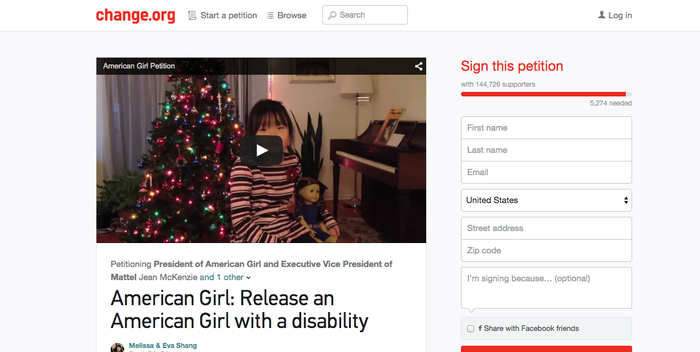
Last winter, my sister Eva helped me petition American Girl, my favorite line of books and dolls, to release a Girl of the Year with a Disability. Our petition gathered almost 150,000 signatures, and was featured in newspapers and magazines from Oprah Magazine to CBS to the International Business Times. Yet American Girl has not yet promised to tell the story of a girl with disability as the main character. Our stories deserve to be heard.


So, I’ve decided to write the book myself. With the help of my sister, we will self-publish a book about a middle school girl who has a neuromuscular disease, like I do, and tell the stories of all the girls who never get to see their own perspectives on the page. To publish the book, we’ll need your support.

The Plot
Mia Lee just wants to fit in—but it’s near impossible when she has a disability. When other sixth-graders are hanging out their lockers between classes, she’s stuck in the handicapped elevator in her wheelchair with her aide.

When Mia hatches a plan to befriend the popular girls in school, she finds herself in a whole lot of drama with her aide Miss Jackson, her best friend Caroline, and even her cool college sister Ella. Can Mia survive middle school with a wheelchair, a sometimes-awesome-sometimes-grumpy older sister, and find a way to be “cool?”

The Authors

YouTube published by TEDx Talks
Melissa Shang is a sixth-grader at Tredyffrin-Easttown Middle School and an advocate for disability representation. She has spoken at TEDxYouth@Hewitt, the United Nations, and the National Constitution Center. Eva Shang is a sophomore at Harvard University, as well as Melissa’s PR agent and #1 fan. Follow them on Twitter @shang_melissa and @eva_shang.

Risks and challenges
Although writing a book is a slow process, we are confident that we will be able to finish the book by September, and hopefully, will self-publish the book through CreateSpace, an Amazon subsidiary. If we have the opportunity to publish through a publishing company and no longer require Kickstarter funds, we will donate money raised to the Muscular Dystrophy Association to fund summer camps for kids with neuromuscular diseases.

To Learn More of the KICK STARTER campaign visit: