Disability News Service, Resources, Diversity, Americans with Disabilities Act; Local and National.

Tuesday, January 26, 2016

John Hopkins Hospital wrongly rescinded job offer to deaf nurse, court rules

Johns Hopkins Hospital violated the federal Americans with Disabilities Act when officials rescinded a job offer to a deaf nurse after she requested a sign-language interpreter, a U.S. District Court judge ruled last week.
article by  for The Baltimore Sun | January 25, 2015
Joseph B. Espo, a lawyer for the nurse, Lauren Searls, called it an "important victory" that could send a message to other medical institutions about the capabilities of deaf workers.

Hopkins had told Searls it was a cost issue in a letter, but in its response to the lawsuit, officials called her employment both a financial hardship and a threat to patient safety, Espo said. U.S. District Judge Catherine C. Blake rejected those arguments, he said.

In a statement to The Baltimore Sun, Hopkins spokeswoman Jania Matthews said, "Johns Hopkins Health System is an equal opportunity employer and believes strongly in diversity and inclusion. We make every effort to honor reasonable requests for accommodation in the workplace and will continue to do so. As a long-standing practice, we do not discuss pending or ongoing litigation."

Searls had just graduated in 2012 from Hopkins' School of Nursing and said she was encouraged to apply for a job on a unit where she had done a clinical rotation as a student, according to the lawsuit. She applied and was offered a job the next day.

She had been supplied with interpreters while a student in the nursing school, but when she asked for such services as an employee of the hospital, she was told the cost wasn't budgeted and couldn't be accommodated, her suit said. Hopkins initially estimated the services could cost $120,000 annually, twice the starting salary of a nurse on the unit, according to the lawsuit.

Searls went on to find a nursing position in January 2013 at the University of Rochester Medical Center's Strong Memorial Hospital, which supplied her with an interpreter and where she continues to work. But in 2014, she filed a lawsuit claiming discrimination under the Americans with Disabilities Act against Hopkins for lost wages, other damages and attorney's fees.

In the suit, she said she would need fewer interpreting resources than she needed while in school. One interpreter would do, which Espo said would cost about $40,000 based on documents obtained from Hopkins. But the issue for the judge, Espo said, was that Hopkins wrongly compared the cost of the interpreter with the nursing salary when it should have compared the cost and hardship to its own budget.

The lawsuit said the budget for the unit in the hospital where Searls would have worked was $3.4 million.

The judge also said there was no evidence of a threat to patient safety by using an interpreter untrained in identifying medical equipment alarms, for example, and noted Searls had been working in Rochester with an interpreter.

Medical institutions in Maryland have faced other criticism from the deaf community. Some patients have complained that interpretation services are inadequate at hospitals around the state. Officials in the Governor's Office of the Deaf and Hard of Hearing have said it is working with hospitals to improve those services and looking at establishing regulations to ensure that only qualified and perhaps only licensed interpreters are used.

Advocates said Congress has repeatedly reaffirmed the rights of deaf and hard-of-hearing individuals, as well as those of people with other disabilities, to "live a full life, equal to that of people without disabilities." A full life includes working, said Caroline Jackson, staff attorney for the National Association of the Deaf Law and Advocacy Center.

Medical institutions routinely support the rights of deaf people, and nationally there are many examples of deaf people working as nurses and doctors, and in other health care careers, including at Hopkins, said Caroline Jackson, staff attorney at the National Association of the DeafLaw and Advocacy Center.

"It is undisputed that Ms. Searls was and is an excellent nurse, which no doubt led to the decision to hire her in the first place," Jackson said. "It is a much better use of society's resources to support Ms. Searls as she excels at nursing, pays taxes and contributes to the overall health of our community, than it is to shut her out from public life and force her to live off society's largesse — for example, public assistance."

Espo said the decision doesn't reflect a larger problem with the entire Hopkins system.

"If the hospital had treated Ms. Searls in the same manner as the nursing school had, she would be working there now," Espo said.

A trial to determine damages has not been scheduled.
http://www.baltimoresun.com/health/bs-hs-deaf-nurse-20160121-story.html

Webinar Feb.11th : Accessible Means of Egress/Emergency Evacuation

Announcing a new webinar - "ADA National Network Learning Session: Accessible Means of Egress/Emergency Evacuation"

February 11th, 2016

Webinars begin at 2.30pm ET/1.30pm CT/12.30 pm MT/11.30am PT/9.30am Hawaii.
Registration: Free on-line at http://www.adapresentations.org/registration.php
The way someone enters and moves into a building is not always the same way they move to evacuate a building in an emergency. In addition to accessible entry, persons with disabilities must be considered when designing plans and building systems used for emergency evacuation. The accessible means of egress provisions from the International Building Code (IBC) are now referenced in the federal design regulations and will be required for all new construction. This webinar will introduce you to the concepts, details and application of exiting provisions, and assist in understanding how the codes and federal regulations are now working to harmonize the national response to designing a building not only for ingress, but for egress as well. Discussions will include operational safety plans, fire drills, notification/communication for occupants in a building during the emergency and physical building requirements.
Learning objectives:
  • Determine what is considered when pre-planning for emergencies.
  • Recognize how people are informed about emergency routes and the need for emergency evacuations.
  • Identify the elements of the accessible means of egress routes and where they are required.
Kimberly Paarlberg is a Senior Staff Architect in Technical Services with the International Code Council (ICC). Her experience with ICC includes work in the plan review and code development departments with responsibilities for code development, plan reviews, providing code interpretations, instructing technical seminars and authoring and reviewing instruction materials, code commentary and publication articles. Kimberly serves as code development secretary for the IBC Means of Egress/Accessibility and ICC Administration committees. She is ICC representative for development of the referenced technical standard, ICC/ANSI A117.1 “Accessible and Usable Buildings and Facilities.”
Before joining ICC, Kimberly worked as a structural engineer and architect. Kim is a licensed architect in Illinois and holds an Accessibility Inspector/Plans Examiner certification.
These 90 minute webinars are delivered using the Blackboard Collaborate webinar platform. Collaborate downloads files to your machine in order to run. We recommend that you prepare your technology prior to the start of the session. You may need the assistance of your IT Staff if firewalls prevent you from downloading files.
To view all of the sessions for the coming year, or to see previous sessions, go to http://www.adapresentations.org/schedule.php
The information presented in this webinar is intended solely as informal guidance, and is neither a determination of legal rights or responsibilities by NIDILRR or FEMA.
# information in post as shared by the ADA National Network.

Monday, January 25, 2016

FTA Webinar ADA Circular Training February 3rd:The ADA and Paratransit

from a Press Release | January 25, 2016

In October 2015, FTA issued its ADA Circular. To help transit agencies and riders get the most out of the Circular, FTA’s Office of Civil Rights is hosting a series of webinars that provide an in-depth look at ADA requirements and how the Circular addresses them. Each hour-long webinar will provide useful information on ADA topics as well as tips and suggestions for providing accessible service. Participants will have an opportunity to ask questions.

Join us for Webinar 2 – The ADA and Paratransit – 2-3 p.m. EST Wednesday, February 3. 
We will address service requirements related to paratransit service criteria, capacity constraints, and trip reservations. For eligibility, we will look at types of eligibility, the eligibility process, and no-show policies. This webinar covers material from Chapters 8 and 9 of the FTA ADA Circular.

The ADA webinar series is designed for FTA grantees. Because attendance space is limited, we request that each agency register for a single spot. Note: this registration link is only for Webinar 2. Registration links for future webinars will be sent out separately.

FTA is committed to providing equal access to this session for all participants. If you need alternative formats, options, or services, please contact FTAcivilrightstrain@dot.gov.

Links:
Register for Webinar 2 – The ADA and Paratransit (link: https://www.surveymonkey.com/r/9WX6LB2)

Related Posts:
FTA Issues Detailed Guidance to Public Transportation Agencies on Implementing Americans with Disabilities Act
New FTA Americans with Disabilities Act Circular, an outline of ADA requirements

Illinois Cook County Sheriff Dart and the National Alliance on Mental Illness blasts Governor Rauner over Mental Health Cuts

Cook County Sheriff Thomas Dart and the National Alliance on Mental Illness denounced Gov. Bruce Rauner this weekend, following the announcement that Lutheran Social Services of Illinois would lay off 750 employees and shut down 30 social services programs because of the state's budget impasse.

nice article by Steve Zalusky for The Daily Herald | January 24, 2016

"Lutheran provides essential services to the very people government is supposed to care for in times of distress," Dart said in a statement released Saturday. "For the governor to allow these programs to wither away is simply deplorable. Without Lutheran's diversion programs, my Cook County Jail population will rise, costing taxpayers significantly more in both the short-term and long-term."

The governor's press office responded Sunday by saying Rauner also is frustrated by the lack of movement in Springfield on the state's nearly seven-month budget stalemate.

"Tom Dart (photo) knows very well that groups like Lutheran Social Services could be fully funded tomorrow if he and Mike Madigan placed a higher priority on social services than defending the out-of-control, job-killing power of special interests," Rauner spokeswoman Catherine Kelly said in an email. "While Governor Rauner stands ready to pass job-creating legislation and fund social services in a balanced budget, Tom Dart and Mike Madigan want special interests to keep their power at the expense of social services."

Lutheran Social Services of Illinois announced the program closures and staff cuts on Thursday, attributing them to the failure of the state to provide necessary funds. The state currently owes LSSI, the largest statewide provider of social services, $6 million. LSSI reports that 4,700 people will lose access to care as a result of the cuts.

Dart's joint statement with NAMI predicts devastating effects on Cook County's most vulnerable communities, particularly those living with mental illness and struggling with addiction. Several of the slashed programs focus specifically on helping nonviolent inmates secure housing and develop marketable employment skills upon leaving the criminal justice system, according to the statement.

Following historic cuts to statewide mental health services in recent years, Dart said, the county jail has emerged as the largest mental health provider in the United States, with typically 25 to 35 percent of its population suffering from mental illness.

"This is a very sad day in our communities, our neighborhoods, our county, our state," said Alexa James, executive director of NAMI Chicago. "Policymakers have decided that our veterans, our seniors, individuals impacted by mental illness and substance abuse disorders are not valued. Where will they seek treatment now?

"We are running out of creative solutions and feel devastated for Lutheran Social Services and the communities they have lifted up for so many years," she added.

http://www.dailyherald.com/article/20160124/news/160129379/

ANNOUNCING THE ABLEGAMERS 2015 ACCESSIBLE GAME OF THE YEAR

January 21, 2016 --The AbleGamers Foundation has announced the Accessible Video Games for 2015.

The year 2015 started to show the true strength of the newest generation of video game consoles, with many blockbuster sequels and creative new ideas releasing on every system. AbleGamers is once again searching through those releases to find what demonstrates the good game design practices of Accessibility. Many games were considered, both mainstream and independent, but only one of each classification stood out beyond the others to be classified as Accessible Game of the Year.

This past year, many advances occurred within the gaming industry to further allow gamers with disabilities options to improve their gaming experiences. Gaming consoles themselves released more options to improve gaming experiences for everyone. The PlayStation 4 and the Xbox One each feature entire accessibility sections on the hardware, allowing gamers to modify their gaming experiences with closed captions, button remapping, zoom functions, higher contrasts, text-to-speech, and more. Both Sony and Microsoft saw the need for these options and included them at the hardware level, which is a huge step forward for accessibility across the entire gaming industry. 2015 also saw the release of accessible controllers, such as the Xbox One Elite controller, as well as the Steam Controller, putting accessible controllers in major retailers and pushing Accessible hardware into the mainstream. We hope to see the major console and hardware manufacturers continue to release accessible products so everyone can game.

The AbleGamers staff have decided on a Mainstream and Indie Accessible GOTY. From a list of many appeared two winners, each exampling accessibility in different forms.

INDIE ACCESSIBLE GAME OF THE YEAR: ROCKET LEAGUE

Rocket League was the surprise indie hit of the year, winning many awards, and earning recognition as a runaway success story all throughout the industry. Yet, a game about cars smashing into each other in an epic soccer battle isn’t exactly something most would think of when it comes to accessibility.

Psyonix went to great lengths to include as many gamers as possible by working with focus groups and gamers of different abilities to ensure a large swath of accessibility.

Right off the bat, Rocket League has fully remappable keys, including one of the most interesting features AbleGamers has seen in a racing game of any kind: Both the X and Y axis controls can be mapped directly to the mouse. If you want to drive left, you move the mouse to the left. If you want to drive forward, you move the mouse forward. In fact, the entire game can be controlled using only the mouse, keyboard, or controller. An impressive feat for a game in this genre.

Team colors are defaulted to orange and blue for colorblind friendly play. Also, visual cues are built directly into the game from shield icons appearing on your team’s goal, so you don’t accidentally score on yourself, to ball position indicators for when the ball goes off screen.

The short, five-minute matches strike an excellent balance between fun and strenuous activity for those who fatigue easily. And although the matches do require faster reflexes, the visual indicators and interactive tutorials make learning the game easy for those with cognitive disabilities.

“We’re extremely honored to receive the “Mainstream Indie Game of the Year Award” from the AbleGamers Charity,” said Corey Davis, Psyonix Design Director. “Our team is thrilled that a wider group of players are finding success with Rocket League in a variety of ways, and it’s humbling to be associated with AbleGamers’ great efforts in the industry. Going forward, we will continue to strive for more “ease of use” solutions in Rocket League’s future. Thank you!”


MAINSTREAM ACCESSIBLE GAME OF THE YEAR: MLB 15 THE SHOW

MLB 15 The Show is a series that reiterates the basics of accessible game design and improves their accessibility more and more each year. MLB 15 The Show features seven different difficulty levels, with the option of a Dynamic difficulty changing based upon your play. The game also allows for automation of individual sets of gameplay, allowing players to choose whether or not they want be in control of batting, pitching, fielding, or running bases.

MLB 15 The Show does not require sound for any part of gameplay, and includes incredibly detailed and complete full closed captioning for the announcers. Visual accessibility is thought of as well, with many different camera options for each section of gameplay, large bars detailing player stats alongside numerical values, as well as a “ball trail” allowing easier following of the ball in play. MLB 15 The Show continues the high accessibility options of past titles, and increases that accessibility with more diverse options every release.

SCEA San Diego studios was thrilled to hear of their win for accessible game of the year, calling the award “awesome” and recalling the serious amount of options included in the game.

MOVING FORWARD
There are many other games that were steps forward for accessibility, and some other mainstream games that failed in every regard. Console manufacturers are demonstrating the value in accessibility, more game developers need to follow suit. To find our Da Vinci Award winning document Includification: “A Practical Guide to Game Accessibility” and to find out more on how to make your game more accessible, visit Includification.com.
http://www.ablegamers.com/ablegamers-news/announcing-the-ablegamers-2015-accessible-game-of-the-year
For The AbleGamers Foundation, visit: http://www.ablegamers.com/

New York City Special-ed Scandal is Real in Regular Public Schools: by New York Post Editorial Board

The latest attack on the city’s largest charter-school network comes via a federal complaint filed by parents of 13 special-education students once or still enrolled in a Success Academy. Yet the real special-ed scandal in this town centers on the shameful way the regular schools fail such children.

Opinion By New York Post Editorial Board on January 26, 2016
The lawsuit accuses Success of failing to provide the necessary resources for “special education pupils . . . while often retaining the students to repeat a grade,” “recommending they transfer back into regular schools,” imposing excessive suspensions, etc.

Here’s the thing: Success and other top charters do special ed the way it’s supposed to be done. They work hard to help these kids learn their way out of the program.

In far too many regular schools, special education is Hotel California: You can never leave. You’re stuck there until they find a way to hand you a worthless diploma.

Indeed, Marcus Winters’ landmark 2013 Manhattan Institute study found that New York City special-ed kids are far more likely to graduate out of the special-ed track in a charter than in a regular school.

Transfers? The numbers, Winters noted, show that more special-ed kids transfer to charter schools than transfer out.

It’s telling that the suit hits Success for refusing to promote kids who aren’t ready for the next grade. That’s worth applause, not a court fight — and it’s what the regular public schools claim to do, as well.

As for resources: Yes, many charters don’t have the resources to assist some special-needs students — because anti-charter forces want it that way.

A third of the city’s regular public schools don’t have enough rooms to accommodate the greatest-need special-needs students, the ones in “12-1-1” programs (12 students, one teacher, one aide). Park Slope special-needs parent Doug McCurry made that point on these pages a year ago. (His son now thrives in a Success school.)

And charter foes do their best to limit charters’ space. They also get far less per-pupil funding from the state.

Of course, it’s not just frustrated parents suing: Joining the suit are Public Advocate Letitia James and City Council Education Committee boss Daniel Dromm, both charter opponents and Success-haters.

If these politicians really cared about children who need special education, they’d be looking to boost Success and other charters, not stifle them.
http://nypost.com/2016/01/24/the-real-special-ed-scandal-is-in-regular-public-schools/

Saturday, January 23, 2016

Low Cost, or Free Dental Care Options for Seniors & People with Disabilities

Access to regular dental care is often difficult for seniors. And people with disabilities. Medicare doesn’t cover it. Medicaid coverage is limited, and depends which state you live in. Out-of-pocket expenses can be prohibitive to those on a fixed income.


Fortunately, there are organizations that can help. Listed are low cost or possible free dental care possible options for seniors, and people with disabilities:

A site dedicated to health resources for older adults is toothwisdom.org. Click on your state here and you’ll find a list of excellent resources. The site is run by Oral Health America (OHA), “a national nonprofit based in Chicago that is dedicated to changing lives by connecting communities with resources to increase access to care, education, and advocacy for all Americans, especially those most vulnerable.”

With Eldercare Locator, a service of the Administration on Aging, you can search by state or by service (health, transportation, legal, etc.). Speak with an information specialist: 1-800-677-1116.

2-1-1 Information and Referral Search is sponsored by the United Way and can connect you to services in your area. Simply dial 211.

 PACE (Program of All-inclusive Care for the Elderly) is a Medicare and Medicaid program that “helps people meet their health care needs in the community…” This healthcare can include dentistry.

The Health Resources and Services Administration (HRSA) supports federally-funded health centers for those with no insurance or limited income. Many offer sliding scale (based on what you can afford) payments. Visit the site or call 1–888–275–4772.

The Dental Lifeline Network (formerly the National Foundation of Dentistry for the Handicapped) provides “access to comprehensive dental services for people with disabilities or who are elderly or medically at-risk.” Call 1-888-471-6334.

The non-profit Dentistry From The Heart (DFTH) provides “free dental care to those in need.” Volunteer dentists and hygienists donate their time for events around the country. Find events here.

Also check out Freemedicalcamps.com to locate free or inexpensive dental care.

Dental schools are an option for good low-cost care as many have clinics where students get experience working on patients. The Commission on Dental Accreditation website has a listing of schools by state. Also try dental hygiene schools for preventative care.

 The National Association of Free and Charitable Clinics is a non-profit that seeks to “broaden access to affordable health care for the medically underserved.” You can search for free care from their homepage.

Dental Lifeline Network Reaches $300 Million In Donated Services to People in Need

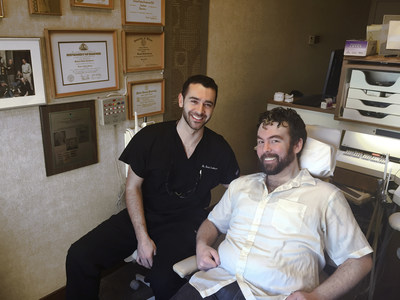
Chicago dentist Dr. David Gershenzon (left) provided dental treatment to Jesse, a patient in Dental Lifeline Network's Donated Dental Services (DDS) program.
photo: Chicago dentist Dr. David Gershenzon (left) provided dental treatment to Jesse, a patient in Dental Lifeline Network's Donated Dental Services (DDS) program.
DENVERNov. 5, 2015 /PRNewswire/ -- Now exceeding $300 million in dental services donated to vulnerable people in desperate need of care, Dental Lifeline Network provides full-service treatment without cost to patients through its extensive volunteer network of dentists and dental laboratories.
People with permanent disabilities or who are elderly or medically fragile and cannot afford dental care may be eligible for DLN's Donated Dental Services (DDS) program which has served 107,000 people since it began 30 years ago in Colorado. Services are available in 50 states and Washington D.C. through DLN and its partner organizations. Its success is due to the generosity of 15,000 dentists and 3,700 labs that volunteer for DDS, according to Fred Leviton, DLN president.
"Many thousands of people in the U.S. suffer from painful dental conditions including fractured teeth, advanced periodontal disease and the inability to eat normally. After years of being unable to afford treatment, these patients' ages or disabilities make the burden of added dental disease devastating for them.  Their lives are transformed through the safety net provided by DDS volunteers," he noted.
Chicago resident Amanda, age 34, has a birth defect that prevented her joints from fully developing. She worked at a bank, but now relies on disability benefits. Amanda types with her mouth. She cracked a tooth and, unable to afford dental care, postponed treatment. Eventually, she connected with the DDS program.
"Every single day that I have a healthy smile and a healthy mouth, I can do the things I need to do and feel confident," Amanda said. "You guys (DDS) did that for me . . thank you!"
More volunteer dentists are always needed. Chicago dentist Dr. David Gershenzon joined his father's practice, and began volunteering for DDS as his father, Dr.Richard Gershenzon, has done for many years.
"It's really meaningful to me to see the look on a patient's face after they've completed treatment and you've really helped improve their lives," Dr. David Gershenzon commented. "It gives me more meaning as to why I'm a dentist." Dr. Gershenzon and DDS patient Amanda are featured in a new video produced as a public service by the American Dental Association. (View at www.DentalLifeline.org).
Increasingly, patients who are medically fragile are referred to DDS. Dental health often is a prerequisite for cancer patients who need chemotherapy, candidates for organ transplants or kidney dialysis, people who require life-saving medications, cardiac patients requiring surgery, and patients with crippling arthritis who need joint replacements.
DLN grew through collaboration with state dental associations. Funding comes from state governments, foundations, some state Delta Dental plans, the dental trade industry and corporate and individual donors.
A charitable affiliate of the American Dental Association, DLN was founded in 1974 by chairman and CEO Dr. Larry Coffee, a graduate of Northwestern University Dental School. To learn more, visit www.DentalLifeline.org or call 888-471-6334. 
SOURCE Dental Lifeline Network

# this is a re-post with updated links as of this date.

Shame on Illinois Budget Impasse, Forces Program Closures & Staffing Cuts At 'Lutheran Social Services' of Illinois

DES PLAINES, Ill.Jan. 22, 2016 /PRNewswire-USNewswire/ -- Lutheran Social Services of Illinois (LSSI), the largest statewide provider of social services, today announced program closures and staff cuts throughout Illinois due to the state's inability to pass a budget for the past seven months.
"The state's budget deadlock has severely challenged LSSI's ability to provide services to those in need," said Mark A. Stutrud, LSSI President and CEO. "Over the past months, LSSI has relied on a bank line of credit and available resources from our foundation to compensate for the state's inability to pay its bills. Currently, we are owed more than $6 million by the state for services delivered. After seven months, we can no longer provide services for which we aren't being paid."
The seven-month-long-and-counting budget impasse forced the organization to cut back programs and restructure services as LSSI seeks to bolster resources for the 149-year-old faith-based nonprofit's continued viability. In consultation with LSSI's Board of Directors and an independent advisory group, LSSI created a plan to restructure its services and shore up resources for the viability and continuation of the organization.
In all, over 30 programs are closing, and more than 750 positions are being eliminated, or 43 percent of LSSI's total employees. As a result of these closures, approximately 4,700 people will no longer be receiving services from LSSI. [A list of programs and communities where services were eliminated is below.]
"We are eliminating spending that is most linked to non-payment of services and redesigning our administrative support around a newly restructured organization," said Stutrud. "Our plans respond to this year's budget impasse and an anticipated lingering state financial crisis over the next several years. We're doing this at a great cost to LSSI and those affected by our services. It has been an agonizing process, particularly its impact on our clients and their families who depend on us for their care, as well as our employees whose jobs were eliminated. Many of our employees are direct care personnel who have built relationships and strong trust with the people they serve."
The programs that saw the largest cuts were those helping seniors, including home care. Programs eliminated were case management for seniors, adult protective services, and LSSI's Adult Day Care Center in Moline. Although LSSI is receiving some payment through Medicaid, the organization has been accruing several hundred thousand dollars a month in unpaid bills for home care services since July 2015, when the state's budget cycle normally would have begun.
LSSI also has not received payment for programs reimbursed through the state's general revenue fund and other state agencies. These include residential rehabilitation for adult drug and alcohol treatment in Chicago and Elgin, community counseling services, and prisoner and family programs at several locations.
LSSI is grateful for the support of ELCA churches statewide, other faith communities, and donors. LSSI is committed to continuing services that include: mental health, alcohol and drug treatment; Head Start; services for at-risk families; residential programs for adults with developmental disabilities, foster care, affordable senior housing; home care, and programs that help children maintain connections to their incarcerated parent. 
"These decisions were the result of a thorough and painful process," said Stutrud. "We know this will impact clients, their families, our employees, and communities throughout Illinois. We made these choices with a long-term view of the organization and its mission, and ultimately the ability to continue serving people."
About Lutheran Social Services of Illinois Founded in 1867, Lutheran Social Services of Illinois (LSSI) is a statewide, nonprofit social service agency of the three Illinois synods of the Evangelical Lutheran Church in America (ELCA). For more information, visit LSSI.org and LSSI's Facebook page.
Programs Affected
Residential Rehabilitation for alcohol and drug treatment Behavioral Health Housing Opportunities, Chicago 
Elgin Residential Rehab, Elgin 
Men's Residence North, Chicago 
Men's Residence West, Elgin 
Social Detox, Chicago 
Women's Residence, Chicago
Mental Health Counseling for children, youth, adults and families Community-based Counseling, Berwyn 
Community-based Counseling, Des Plaines  
Community-based Counseling, Downers Grove 
Community-based Counseling, Elmhurst 
Community-based Counseling, Mendota 
Community-based Counseling, Prospect Heights 
Community-based Counseling, Wheaton  
Dixon General Counseling, Dixon 
West/Northwest Suburban Counseling, Villa Park
Youth Services School-Based Counseling Services, Sterling 
Youth Emergency Shelter, Nachusa 
Re-entry Services for former prisoners and their families Connections, Chicago 
Employment Skills School, East St. Louis 
Homeward Bound Supportive Housing, East St. Louis 
River Bend Re-entry, Alton
In-home Support Services for seniors Intouch Home Care, Canton (serving Fulton County
Intouch Home Care, Chicago (serving Chicago South and Southern Cook County
Intouch Home Care, DeKalb (serving DeKalbKendallLa Salle Counties) 
Intouch Home Care, Freeport (serving StephensonJo Daviess Counties)  
Intouch Home Care, Moline (serving Rock IslandHenryMercer Counties) 
Intouch Home Care, Peoria (serving PeoriaMarshallStarkTazewellWoodford Counties) 
Intouch Home Care, Rockford (serving WinnebagoBooneOgle Counties)
Respite Services supporting veterans and their families Legacy Corps, Rockford 
Legacy Corps, Streamwood
Adult Day Care for seniors and adults 18+ with disabilities Intouch Adult Day, Moline
Comprehensive Case Management and Protective Services for seniors Case Coordination, Sterling 
Adult Protective Services, Sterling

Friday, January 22, 2016

EEOC Seeks Public Input by February 24, 2016 - on Draft Proposed Enforcement Guidance on Retaliation and Related Issues

from a Press Release | January, 21, 2016
U.S. Equal Employment Opportunity Commission (EEOC)

WASHINGTON - The U.S. Equal Employment Opportunity Commission (EEOC) announced today that it has voted to seek public input on proposed enforcement guidance addressing retaliation and related issues under federal employment discrimination laws. The Commission's enforcement guidance documents inform the public about the Commission's interpretation of the law and promote voluntary compliance.
All of the laws EEOC enforces make it illegal to fire, demote, harass, or otherwise "retaliate" against applicants or employees because they complained to their employer about discrimination on the job, filed a charge of discrimination with EEOC, participated in an employment discrimination proceeding (such as an investigation or lawsuit), or engaged in any other "protected activity" under employment discrimination laws.
The Commission's last guidance update on the subject of retaliation was issued in 1998. Since that time the Supreme Court and lower courts have issued numerous significant rulings regarding retaliation under employment discrimination laws.
"Retaliation is a persistent and widespread problem in the nation's workplaces," said EEOC Chair Jenny R. Yang. "Ensuring that employees are free to come forward to report violations of our employment discrimination laws is the cornerstone for effective enforcement. If employees face retaliation for filing a charge, it undermines the protections of our federal civil rights laws. The Commission's request for public input on this proposed enforcement guidance will promote transparency. It will also strengthen EEOC's ability to help employers prevent retaliation and to help employees understand their rights."
The percentage of retaliation charges has roughly doubled since 1998, making retaliation the most frequently alleged type of violation raised with EEOC. Nearly 43 percent of all private sector charges filed in fiscal year 2014 included retaliation claims. In the federal sector, retaliation has been the most frequently alleged basis since 2008, and retaliation violations comprised 53 percent of all violations found in the federal sector in fiscal year 2015.
The draft guidance is available for review at http://www.regulations.gov/#!docketDetail;D=EEOC-2016-0001
The 30-day input period ends on February 24, 2016. Please provide input in narrative form; do not submit redlined versions of the document. The public is invited to submit its input usingwww.regulations.gov in letter, email, or memoranda format. Alternatively, hard copies may be mailed to Public Input, EEOC, Executive Officer, 131 M Street, N.E., Washington, D.C. 20507. 
The input provided will be posted publicly on www.regulations.gov and may show email addresses. Please do not include other personal information that you would not want made public, e.g., home address, telephone number, etc.
After reviewing the public input received, the Commission will consider appropriate revisions to the draft guidance before finalizing it. A final guidance on retaliation and related issues would replace the existing Compliance Manual on Retaliation that was issued in 1998.
Last summer, the Commission gathered public input on retaliation  issues and best practices from a wide range of witnesses at a June 17, 2015 meeting on "Retaliation in the Workplace:  Causes, Remedies, and Strategies for Prevention."
EEOC enforces federal laws prohibiting employment discrimination. Further information about EEOC is available on its web site at www.eeoc.gov.
http://www.eeoc.gov/eeoc/newsroom/release/1-21-16a.cfm