Disability News Service, Resources, Diversity, Americans with Disabilities Act; Local and National.

Monday, December 21, 2015

Some of The World’s Most Wheelchair Friendly Cities

article by  Helen Campbell, travel consultant for Ability Chicago Info | Dec. 21, 2015

Travel is a great thing to do with your time. It’s fun, it broadens the mind, it gives you a new perspective on things, and it can even make you a better person! However, if you use a wheelchair, travel is a lot more complex than it is for most people. Plenty of destinations, sadly, simply aren’t suitable for wheelchair users – indeed, ancient European cities with their narrow, steep cobbled streets often seem purposely designed to impede the progress of those who rely upon wheels. However, if you do want to travel abroad and don’t want to let your wheelchair hold you back, fear not. You’d be amazed at how ingeniously some cities have managed to make even their most ancient and step-ridden architecture accessible and disability-friendly! Here is a quick list of the best cities to travel to if you want to head abroad with your wheelchair.

London
Like most European countries, the UK has stringent disability access laws, which means that the city has done its level best to ensure that its attractions are available to all, no matter their physical ability. Of course, given the tremendously ancient nature of some of London’s buildings it has not always been possible to, for example, install ramps and lifts onto centuries old stone steps, but all staff at public attractions are trained to do their utmost to ensure that nobody misses out, no matter their level of disability. London is quite spread out, and the London Underground takes a bit of pre-planning for wheelchair users, but all taxis and buses are required by law to be wheelchair friendly so the city is not too tricky to get around. You’ll also find that London attractions are quite sympathetic to the experience of disabled individuals, often offering discounts and allowing carers to get in for free. If you have a chronic health condition which may require treatment during your stay, it’s worth noting that the UK has nationalized healthcare, so you probably won’t be asked for payment. However, if the nurses remember (British healthcare professionals aren’t used to asking for money so it often does not occur to them!), you may be asked for your details so that payment can be followed up at a later date.

Melbourne
Melbourne in Australia has several advantages over its European counterparts. For a start, like the cities in the USA, it’s relatively new, which means that streets have been laid down according to a single plan rather than evolving over millennia into complex, twisty wheelchair-nightmares. Melbourne also provides comprehensive ‘mobility maps’ which can be accessed via apps, and make planning your stay in the city extremely easy. If you’re a sports fan, Melbourne is one of the easiest places in which to take in a game – stadiums are designed with the needs of wheelchair users in mind, and there are always lots of wheelchair spots.

Munich
With typical German efficiency, the people of Munich have devoted considerable time and resources to making their city wheelchair friendly. There are hardly any barriers at stations, and the vast majority of U-Bahn and S-Bahn services are easily wheelchair accessible. While cobbles and steep hills may present a problem for many wheelchair users, there is never any shortage of city officials to lend a hand in tricky spots! Plenty of attractions (the BMW Museum, the Englischer Garten, and the famous Frauenkirche to name but a few) are free of cumbersome barriers, and for those which are more difficult to get into, there are (again) well-trained staff on hand to quickly and efficiently solve any access issues.

Stockholm
The Swedish capital is already reasonably wheelchair friendly, but the Swedish authorities are currently implementing measures to make it even more inclusive. All new buses, trains, stations, and other infrastructure implementations are designed to make them as accessible as they possibly could be for wheelchair users. Meanwhile, city attractions are being encouraged to train staff and introduce measures which will make visiting a lot easier for people with disabilities. Taking inspiration from London, Stockholm is also placing discreet disabled-friendly public toilets throughout the city, to save people in wheelchairs from having to manoeuvre their way through crowded public venues if they need the toilet. Accessibility is one of the key features of Stockholm’s ‘Vision 2030’ plan, and it’s already come a long way towards achieving many of its ideals.

Need for Home Caregivers in States Grows, data shows : Understanding Disability

To commemorate the 25th anniversary of enactment of the Americans with Disabilities Act, the U.S. Census Bureau created a demographic snapshot of the U.S. population with a disability, and examined various services available to them.
nice article by Andy Winnegar, for the Santa Fe New Mexican | Dec. 20, 2015
The statistics provided in the report came from various Census Bureau surveys and data covering differing periods of time.
In 2010, 56.7 million individuals the United States reported having a disability, according to the Survey of Income and Program Participation.
People with disabilities represented 19 percent of the civilian noninstitutionalized population.
A person with a disability, according to the ADA definition, may have a physical or mental impairment that affects one or more major life activities, such as walking, bathing, dressing, eating, preparing meals, going outside the home or doing housework.
There were 25,899 businesses providing services for people with disabilities in the U.S. in 2012, according to the Economic Census Industry Series.
These companies employed 911,331 workers, generating $34.4 billion in revenues — a 7 percent increase since 2007.
Although a disability can occur at birth or at any point in a person’s life, according to the American Community Survey, 28 percent of people with disabilities were 65 and older in 2014 and 39 percent of the population in this age group had at least one disability.
Of this group, two-thirds had difficulty in walking or climbing.
The second-most cited disability for those over 65 was difficulty with living independently, such as visiting a doctor’s office or shopping.
According to the 2014 census data, New Mexico was ranked eighth in the country for households with one or more people 65 or older, and this population is increasing at a faster rate than the national average.
There is an increasing demand for in-home support services for both seniors and others with disabilities, according to Adrienne Smith, who heads the New Mexico Direct Caregivers Coalition.
Smith said the coalition was organized because of the huge increase in the direct care workers who make up the fastest-growing set of occupations in New Mexico.
“There are 60,728 direct care workers and another 417,000 who serve as an unpaid family caregiver at any one time during the year,” she said.
The coalition supports caregivers by providing education and training and offers an opportunity to sit for a nationally recognized credential, Smith said.
But care recipients and their families need to obtain recommendations, references and background checks before employing a caregiver, she said.
“The profession is one characterized by low pay, $9.01 on average in New Mexico,” Smith said.
Consequently, according to Smith, these are workers who often must work multiple jobs just to make ends meet, leaving little time for training or professional development.
The marketing company Seniorcare.com, which provides a nationwide online directory by ZIP code at www.homehealthcareagencies.com, identified more than 26 agencies providing home care services within 41 miles of Santa Fe.
These companies provide anything from escorted transportation, to assistance with household chores, personal hygiene and pet care.
“We envision the day when the New Mexico caregiver is paid a living wage for a job with opportunities for growth, advancement and recognition for their valuable work with persons who are elderly and those with disabilities,” Smith said.
According to IRS Publication 926, even if you hire someone through an agency, you still need to make sure who is paying the employment taxes.
The worker is considered your employee if you can control their work and how it is done.
If so, under the IRS rules, you would have the obligation to withhold and to pay payroll taxes that apply to employers.
If the worker is self-employed, they will usually provide their own tools and offer services as an independent business or contractor and are responsible for their own taxes.
For more information, visit the IRS website, www.irs.gov/pub926.
Andy Winnegar has spent his career in rehabilitation and is based in Santa Fe as a training associate for the Southwest ADA Center, 800-949-4232. He can be reached at a@winnegar.com.
http://www.santafenewmexican.com/news/health_and_science/understanding-disability-need-for-caregivers-in-state-grows-data-shows/article_6e421604-24bb-5677-9b32-5248768c39d3.html

Friday, December 18, 2015

The Complete Guide to Collegiate Adaptive Sports

Choosing a College or University is a huge decision that ultimately impacts the rest of your life. That’s a difficult choice, even with so much information proudly displayed on the school’s admissions homepage. When the details of adaptive sports programs are buried so deeply they can seem impossible to find, it begins to feel overwhelming.
Photo courtesy of the University of Illinois women's wheelchair basketball team
We think that adaptive sports programs are something that should be celebrated, and that’s why we want to take a minute to shine a light on Colleges and Universities across the country that proudly promote their adaptive sports programs.
For a list of Colleges and Universities that proudly support adaptive sports!

The information in this post is from © GOGRIT.US

Chicago Caregiver Latesha Miller who Stole from Hospice Patient Sentenced to 6 years

A Chicago caretaker was sentenced to six years in prison Friday for stealing from two patients, including a woman living her last days in hospice care.

Latesha Miller, 38, (pictured) pleaded guilty Friday morning to one count of aggravated identity theft and one count of financial exploitation of an elderly person, both Class 2 felonies, according to a statement from the DuPage County state’s attorney’s office.

Miller was working for a home healthcare agency when she stole two checks from a Winfield woman in her care, the state’s attorney’s office said.

Between Aug. 19 and Aug. 21, 2014, Miller made one check out to an acquaintance in the amount of $499.50, prosecutors claim. The friend cashed the check, kept $200 for herself and gave the rest back to Miller.

Miller allegedly wrote a second check to the friend in the amount of $6,856, but the friend could not cash it because the account had been frozen, prosecutors said.

The victim was a woman receiving hospice care in her home, and has since died, authorities said.

Miller is also accused of stealing a credit card and several checks from an 86-year-old woman living at the Spring Meadows senior living facility in Naperville in August 2013, prosecutors said.

At the time, Miller was working as a certified nursing assistant at the facility. She used the victim’s credit cards to make personal purchases, and made unauthorized deposits into her own bank account from the victim’s checking account, prosecutors claim.

Prosecutors also claim Miller also tried to open up lines of credit using the resident’s personal information. The resident’s daughter called police after noticing discrepancies in her mother’s bank account, authorities said.

Judge Brian Telander sentenced Miller, who lives in the 7300 block of South Wolcott, to six years in the Illinois Department of Corrections.
“[Miller’s] victims, an 86 year-old woman and a terminally ill woman, needed medical help in their daily lives and trusted Ms. Miller to provide that help,” DuPage County State’s Attorney Robert Berlin said in the statement. “Ms. Miller however, had no intentions of helping these women. She saw them as nothing more than easy targets.”
Miller will be required to serve at least 50 percent of her sentence before she is eligible for parole, prosecutors said. She was also ordered to pay $9,420.16 in restitution

WRITTEN BY CHICAGO SUN-TIMES WIRE | 12/18/201
http://chicago.suntimes.com/news/7/71/1192050/caretaker-gets-6-years-stealing-elderly-patients

Feds to Increase Special Education Spending

Increase Would Touch All Ages

Congress plans to put more money into special education under the omnibus federal budget deal announced Wednesday, and infants and toddlers would see a slight edge when it comes to the percentage of increase—though not in overall dollars spent.
article By  , Education WeekDecember 17, 2015
The agreement is moving through Congress and is expected to be signed when it reaches the president's desk.
The Individuals with Disabilities Education Act has three sections that provide grants to states for education. Part B, which educates children ages 6-21, would grow from about $11.5 billion to $11.9 billion, or 3.5 percent. 
IDEA Part B Section 619, often just referred to as "Section 619," applies to children ages 3-5. This program would grow from about $353 million to $368 million, which represents an increase of around 4 percent.
Part C of the IDEA pays for early intervention services for infants and toddlers. It would see a 4.5 percent boost, from about $439 million to $458 million. 
Even combined, Section 619 and Part C make up just a fraction of the money that is spent for children and youth ages 6 to 21. In fiscal 2015, Part C saw a tiny $58,000 increase, while Section 619 was level-funded.
So, the fact that the programs would receive a funding increase in the fiscal 2016 budget could mean that they're riding a wave of interest in early-childhood education that came from the debate over the Every Student Succeeds Act, the latest revision to the Elementary and Secondary Education Act. ESSA includes a $250 million preschool development grant program intended to help states collaborate and coordinate among their different early-childhood systems.

Other Special Education Programs

The budget proposal would allot an additional $2 million to the Jacob K. Javits Gifted and Talented Education Program, which funds research into supporting underrepresented students in gifted education. The National Center for Special Education Research, which was funded at $54 million in fiscal 2015, would remain at that level for fiscal 2016. 
http://blogs.edweek.org/edweek/speced/2015/12/federal_special_education_spending.html

Wednesday, December 16, 2015

2015 Santa's Reindeer Cam Live, Enjoy The Season!


When does Santa feed the reindeer?


WEEKDAYS
PST (Pacific) – 8AM, 3PM & 6PM
MST (Mountain) – 9AM, 4PM & 7PM
CST (Central) – 10AM, 5PM & 8PM
EDT (Eastern) – 11AM, 6PM & 9PM
GMT UTC – 4PM, 11PM, 2AM

WEEKENDS
PST (Pacific) – 3PM
MST (Mountain) – 4PM
CST (Central) – 5PM
EDT (Eastern) – 6PM
GMT UTC – 11PM

How do you get on the Reindeer Nice List?

Visit ReindeerCam Live, and enjoy Santa's Official Reindeer Live Stream website at:


Disability Friendly Travel Ideas

Having a disability doesn’t mean you can’t travel. In fact, with the travel industry making great strides to tackle barriers for disabled travel in recent years, there have never been more options than there are today. So in reality, the question for disabled people is slowly shifting from ‘where can I go?’, to ‘where do I want to go?’

"article by Helen Campbell" for Ability Chicago Info | Dec 16, 2016

In this article, we’ll showcase some of the options available and also offer some advice on how to manage some practical issues.

Before You Travel
How you manage your disability on a day to day basis won’t apply when you’re traveling, so it’s important that you make provisions for how you’ll handle life on the road. Transport, medication, mobility, and what you’ll do if something goes wrong are all things you need to think about.

Thankfully, many travel related industries have procedures in place for accommodating disabled people, especially in the United States, so make sure you speak to them before you travel. Airlines and hotels will help you in a number of ways, from making sure you get on and off the flight safely, have disabled facilities in your room, and can even help with transportation to and from the airport.

If you require medication, it’s advisable that you take more than you think you’ll need. You never know when things will go wrong, and if plans change or a bag with your medication goes missing, you’ll be thankful you brought along extra. If you’re bring large quantities, take a note from your doctor to show the screening agent at the airport.

Where to Go?
Now to the fun part! Where do you want to go on your travels? It’s a big world out there, but for this article we’re going to focus on ideas and destinations that are within easy reach of Chicago.

National Parks
The outdoors has always been perceived as cut off for disabled people, but that’s just not true anymore. Thanks to the efforts of the National Park Service, it’s never been easier to discover the grand beauty of the United States.

Yosemite National Park

California’s gem of a National Park might just be the country’s best. Trees, waterfalls, imposing granite mountains are what await its visitors - including those with mobility issues. A lot of the scenic overlooks are wheelchair accessible, as are many of tour buses. In Yosemite, there are only a few features that are not accessible - making it an excellent place to explore!

Yellowstone National Park
The original - and still the best, some say - National Park is widely disabled friendly, with the majority of the park’s greatest highlights accessed via short scenic overlooks. The famous geysers, including Old Faithful, can also be easily accessed by the disabled.

Disney World
Of all the destinations, it is Disney World that have taken the most steps forward when it comes to disabled access. While not every attraction is wheelchair accessible, many are, and they also helpfully list what level of mobility is required for each ride.
The number of attractions that can be accessed while remaining in a wheelchair is large, more than enough to cover a weekend of fun, making it an excellent family destination. There’s also a system that allows guests with disabilities to avoid long lines and return later at a specific time.

Beaches
Sand is typically the enemy of wheelchairs, but that won't stop you from enjoying a day out at the following beaches. The famous beaches of California, such Malibu and Santa Monica, are usually really well accessed by wheelchairs, as are the picturesque boardwalks that line Virginia’s beaches. Key Largo, in Florida, goes one step further. Not only is the beach accessible, but several local companies even provide opportunities for the disabled to go diving in the warm and clear water...or you can just stay on the beach and relax as the world goes by. Either way, these are two great opportunities to have at a place - the beach - that has historically been cut off from people with mobility issues.

It hasn’t always been easy for disabled people to travel. However, with a focused effort from airlines, hotels, and attractions underway, it’s becoming a little less difficult. With progress being made all the time, it’s only a matter of time until more and more sights become open for everybody.

Ty to Helen Campbell for article!

FY16 Omnibus Spending Bill Released! funds 12 appropriations bills, Transportation, Housing, and Related Agencies bill

as shared from the 'National Low Income Housing Coalition'


FY16 Omnibus Spending Bill Released

Congressional leaders released the text of the omnibus spending bill at about 1:30 am on December 16. The omnibus bill funds all 12 appropriations bills, including the Transportation, Housing and Urban Development, and Related Agencies bill, for FY16.
Congress is currently operating under a Continuing Resolution (CR), which will keep the government funded until midnight December 16. Sometime on December 16 Congress will pass another CR to avoid shutdown until December 22. It is possible that both the House and Senate could take up the omnibus and be done by December 18.
The text of a tax extender package was also released just after midnight.
The omnibus spending bill is not perfect, or even acceptable in our land of riches, but we know that it could have been a lot worse if we were not successful in raising the sequester spending caps and then convincing Congress to put some of these increased resources into key programs. Thank you to all housing advocates who worked so hard with NLIHC and our partners this year to convince Congress to raise the harmful spending caps, sufficiently fund federal homeless and affordable housing programs, and protect the National Housing Trust Fund (NHTF).

Highlights of the omnibus spending bill related to homeless and housing programs:

  • National Housing Trust Fund – No NHTF funds were raided!!
  • HOME – Small increase of $50 million above FY15 level to $950M for FY16!!
  • Vouchers – Appears short on renewals by about $369 million; only new vouchers are VASH vouchers.
  • Homeless Assistance Grants – Increase over FY15’s $2.135B to $2.250B.
  • Project-Based Rental Assistance – Appears short on renewal funding by about $200 million.
  • Public Housing Operating and Capital Funds – Small increases for both!
  • Fair housing policy riders – None!
  • Moving to Work – Reduces the Senate’s proposed expansion from 300 to 100 agencies and adds research protocols, as well as some modest reforms.
The omnibus spending bill would not raid any funds from the National Housing Trust Fund, which is set to deliver its first resources to states in 2016 for the production, preservation, and operation of predominantly affordable rental housing for extremely low income households. The House spending bill would have raided 100% of the NHTF’s funds in 2016 and used them to fund the HOME program. The Senate Committee bill did not raid the NHTF program.
The omnibus bill would provide a $50 million increase compared to FY15 for the HOME program, bringing HOME funding to $950 million, a major victory for HOME program advocates. The House bill would have cut HOME to $767 million in FY16; the Senate bill would have effectively eliminated funding for the HOME program by cutting it to $66 million in FY16.
The omnibus bill would fund the overall Housing Choice Voucher program at $19.629 billion, providing $17.681 for voucher renewals and $65 million for new vouchers (all of the new vouchers are Veterans Affairs Supportive Housing vouchers). It appears that the voucher renewal amount is about $369 million lower than what’s required for 2016 but further analysis is necessary. Renewal numbers are very mercurial things to pin down.
The omnibus bill would fund HUD’s Homeless Assistance Grant programs at $2.25 billion. The President’s budget request would have increased funding to $2.48 billion in FY16 to support efforts to end veteran homelessness in 2015, end chronic homelessness in 2017, and end homelessness for families, youth, and children in 2020.
For the renewal of Project-Based Rental Assistance contracts, the bill would provide $10.62 billion, which appears to be about $200 million less than the latest renewal need numbers. The renewal costs for FY16 increased significantly over FY15 levels because of a shift implemented in FY15 to calendar-year funding for the contract renewals. The shift resulted in savings for FY15 but meant appropriators would need to increase funding for FY16, a big challenge in a year of constrained resources. The FY15 appropriation for PBRA renewals was $9.73 billion.
Funding for Public Housing operating and capital funds remains insufficient overall, but the omnibus did increase the two public housing funding accounts compared to FY15 levels. In FY15, the operating fund received $4.44 billion and the capital fund received $1.875 billion. For FY16, the omnibus would provide $4.5 billion for the operating fund and $1.9 billion for the capital fund.
The House version of the THUD spending bill included three dangerous anti-fair housing provisions that are not included in the omnibus spending bill. The House bill would have prohibited HUD from implementing, enforcing, or administering the Affirmatively Furthering Fair Housing rule or its related Affirmatively Furthering Fair Housing Assessment Tool; prohibited HUD from implementing or enforcing the disparate impact standard of the Fair Housing Act; and prohibited any Fair Housing Initiative Program (FHIP) funds be used for the Private Enforcement Initiative (PEI). PEI grants support local, private fair housing groups’ testing, complaint intake, and investigation efforts. These are agencies that are critical to enforcement of the Fair Housing Act. The provision in the original House bill did not cut total fair housing funds but transferred the FHIP funds to the public agencies that engage in fair housing activities.
The Senate Committee bill would have required the HUD Secretary to expand of the number of Public Housing Agencies (PHAs) that can participate in HUD’s Moving to Work (MTW) demonstration by 300 agencies; the omnibus authorizes 100 new MTW agencies over seven years. The omnibus includes some significant research protocols, a big improvement over the Senate Committee’s bill. But key reforms remain missing such as retaining income targeting standards and protecting voucher funds from being emptied by MTW agencies.
Within Rural Development, the omnibus would provide $1.38 billion for Section 521 Rental Assistance, a significant increase compared to FY15’s $1.167 billion, which proved significantly insufficient to meet FY15’s renewal needs. The omnibus bill would also increase funds for the rural housing voucher program.

Other notes regarding the omnibus:

  • HOPWA is increased slightly from $330 million to $335 million.
  • HUD’s Office of Healthy Homes and Lead Hazard Control is level-funded at $110 million (the House bill would have cut it to $75 million).
  • The Section 811 Housing for Persons with Disabilities program is funded at $151 million, an increase compared to FY15’s $135 million.
The tax extenders package would make the 9% minimum Low Income Housing Tax Credit floor permanent, and make it retroactive to January 1, 2015. The House is expected to consider the tax extender package separately from the omnibus. Both will be merged into one vehicle prior to subsequent Senate action.

Background and Resources:

The House passed its THUD bill on June 9 but the Senate never took up its version of the bill after the Senate Committee on Appropriations approved it on June 25 (see two NLIHC articles on the House bill, Bill Raiding NHTF Passes House, Defense Moves to Senate and House Narrowly Passes THUD Bill with Anti-Fair Housing Provisions and two articles on the Senate Committee bill, Senate Committee Passes Sequester-Constrained THUD Bill and NHTF Spared in Senate THUD Bill).
To view updated FY16 HUD and USDA Budget Chart, visit:  http://nlihc.org/sites/default/files/FY16HUD-USDA_Budget-Chart.pdf
To view the entire tax extender package, visit: http://docs.house.gov/billsthisweek/20151214/R121515.006.xml

The Housing Crisis Facing Americans With Disabilities

             Nowhere to Go

For millions of renters with limited mobility and other physical challenges, there are few homes and apartments on the market that work for them.
nice article by GILLIAN B. WHITE for The Atlantic | Dec 15, 2015
Even for those who are flexible about location and amenities, finding an apartment can be a serious ordeal. But it only becomes harder for those whose disabilities require very specific features, such as doorways that can fit a walker or a wheelchair or door handles that are easier to grip than knobs.

A new report from Harvard finds that more than 7 million renter households have a member with a disability. (According to the Census Bureau, about 57 million Americans, or 19 percent of the U.S. population have a disability, many of whom are senior citizens.) The most common challenges associated with these disabilities involve mobility and difficulty with lifting or grasping objects. There are five features that are considered basic when it comes to accessibility. To help those who struggle with mobility, the most common disability challenge, it’s important to have a step-free entryway, a single-floor layout, and wide doors and hallways. For those who struggle with grip, it helps to have door handles in the form of levers instead of knobs. And for those who are are not of average height or use a wheelchair, electrical controls such as light switches should be accessible from lower heights. While not every person with a disability needs all five features, only 1 percent of rental housing (about 365,000 apartment units) include all of them, according to the report.

The supply of disability-accommodating apartments is slimmest in the northeast, because the region’s buildings are relatively old, meaning that there are a lot of walk-ups and narrow houses. Since 1991, any new building with four or more units must include at least some accessibility features. But even new buildings often aren’t that accessible for the disabled and the elderly. While many offer one or two of those five features, very few offer enough to make them accessible for a wide array of disabilities. Of buildings erected in 2003 and later, only about 6 percent include all those features, the report finds. And of large multi-family buildings, those with 20 or more units, only about 11 percent include all the basic features. Very few single-family homes—which account for 40 percent of rental properties—offer accessibility features at all, and they’re not required to. And in some places, especially more rural locales, those are the only types of rental properties available.

It may seem like having just a few of these features is a start, and having all of them may not even be necessary, depending upon the needs of residents. But the stock of rentals for those with disabilities is already limited, and when apartments made with accessibility in mind don’t offer a wide range of features, that can make the pool even smaller for someone with specific needs. It’s also true that disabilities, especially those that come with age or ailment, can worsen over time, which means that, after five years in the same apartment, someone might need more features than when they moved in. Without a properly outfitted space, people can, when they most need stability, be left hunting for that rare apartment that fits their evolving needs.

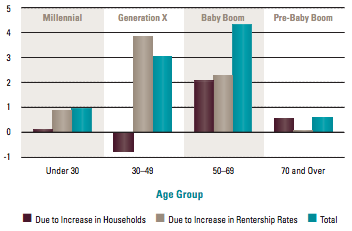
Rental Growth, by Generation
Harvard JCHS
Thinking about the quality of the rental stock is especially important now, as the population of the U.S. is starting to skew older and the share of Baby Boomers who rent instead of own increases. In fact, the over-50 age group has grown significantly in the past decade, making up more than 50 percent of all rental growth during that period. As this cohort ages, it’s going to be a problem that so few rentals cater to those who, say, have difficulty walking or suffer from chronic arthritis. Many of these people will be on a limited budget but won’t qualify for government assistance, limiting their options further.

In November, The New York Times profiled Frederick Jones, a Crown Heights resident who, at 85, has had parts of two toes amputated, which can make climbing the steps to his apartment nearly impossible. But his building, which is one of the few he can afford in a gentrifying neighborhood, doesn’t have an elevator. As someone who made too much in his lifetime to qualify as low-income, but made too little to afford skyrocketing rental prices, Jones has few housing options. That means that he is left in an apartment that makes it difficult for him to even get outside for things such as doctor’s appointments or groceries.

The task of making apartments more accessible isn’t impossible, but at the moment, there aren’t enough incentives to make it a priority to those who could have a hand in it: Landlords by and large won’t invest unless they are receiving federal funds in return for making these changes, and developers are held only to relatively small quotas when constructing new buildings. That means that in an apartment that isn’t quite a fit but is still up to code, the burden of making it accessible falls on disabled tenants and their families. And in a rental market that’s growing increasingly crowded and increasingly expensive, many can’t shoulder that cost.

http://www.theatlantic.com/business/archive/2015/12/renting-with-a-disability/420555/

Prosecutors Weigh Severely Disabled Illinois Man's Death After Incident at State Institution

CENTRALIA, Ill. — Like most of the severely disabled residents at the Warren G. Murray Developmental Center in southern Illinois, Todd Clementz stuck to a routine: Deaf, blind and requiring constant supervision, he passed his days with meals, therapy and an evening bath.
By ALAN SCHER ZAGIER Associated Press | Dec 16, 2015
But in late March, Todd Clementz routine was disrupted when a worker at the state hospital gave him an unscheduled shower, during which the 46-year-old man choked to death. A jury in a coroner's inquest last month ruled his death a homicide.
Clinton County State's Attorney John Hudspeth told The Associated Press on Tuesday that he expects to decide soon whether to file criminal charges. The AP is not naming the former employee of the facility in Centralia. He was initially placed on administrative leave but later was fired for seeking work at another state agency during an internal investigation, according to Veronica Vera, a spokeswoman for the Illinois Department of Human Services that oversees the developmental center.
Tom Hatley, a state police investigator, testified at the coroner's inquest that the mental health technician who gave Clementz the shower told him that Clementz had missed his regularly scheduled bath "because he was exhibiting a behavior." Other workers testified that the forced shower was meant to help keep Clementz from going to sleep earlier than scheduled.
Within minutes, Clementz began choking on the cold water being sprayed from a hand-held shower wand, the trooper testified. His lips turned blue as he became unconscious and went into cardiac arrest. An autopsy determined Clementz died from choking on cold water as well as regurgitated food.
"This gentleman was waterboarded," said Tony Pauluski, executive director of  The ARC of Illinois, an advocacy group that wants the state to close all of its developmental centers by 2020.
Hatley said several co-workers of the technician — who is at least 6 feet tall and about 250 pounds — said he had previously given forced showers to discipline uncooperative residents. The trooper said he wasn't able to independently corroborate those accounts.
Vera said Clementz's death led to increased staff training and supervision, among other changes, including the replacement of suctioning machines designed to stop patients from choking.
But the death has ramped up pressure on the state to close the facility and six others that remain open. Other states are increasingly turning to smaller, community-based treatment options spurred by an evolving consensus on treatment and a series of federal court rulings.
Only Texas and New Jersey house more adults with mental or physical disabilities in state institutions. Thirteen states, including neighboring Indiana and Michigan, have closed all such facilities. At least 1,700 Illinois residents call the state developmental centers home.
Then-Gov. Pat Quinn targeted the Murray Center for closure in a 2012 cost-cutting move. But parents and guardians of patients at the institution and others like it sued in federal court, alleging it would violate the Americans with Disabilities Act.
In October, a three-judge panel of the 7th U.S. Circuit Court of Appeals upheld a district court ruling that sided with the state. The ruling deemed Illinois a "laggard outlier" in the national move away from institutionalization.
Rita Winkeler, a retired third-grade teacher who heads the Murray Parents Association, called Clementz's death an anomaly.
She says her son and others with severe disabilities would not be able to receive adequate treatment at smaller facilities. Mark Winkeler, 31, is a 20-year Murray Center resident with an IQ of 12, who can't speak and is unable to feed, dress or bathe himself, or use the bathroom on his own.
At 6-foot-3, but with severe osteoporosis, he walks haltingly with a pronounced hunch, his feet turned inward while navigating a living area where most other residents are bedridden or use wheelchairs.
"These parents — I think everyone would dream that their kids can live in the community," his mother said. "But one size doesn't fit all."